Identify what you WANT
Most of us think that reading the job descriptions that companies put on their websites should tell us enough about whether or not we should apply. There's a process that can help sharpen your job search.
Be specific
Most of us find our ways to jobs by reading job descriptions on company website or modelling our careers on the people we know and feel a closeness to. On the surface this seems straightforward, and it should work. In fact, sometimes it does. And if it has then this is not relevant to you.
Many of my clients, come to me because this approach has not worked. And it hasn't worked because they are looking for specific things: skills they want to use, environments they like to be in, managers with specific attitudes or flexibility requirements that are unique to them. They have implicit criteria that they are unable to explain but usually are able to identify when they are absent.
Putting yourself in situations and then realizing that you are making trade-offs you don't want to be making is costly in terms of time, but also emotionally and physically. The problem gets magnified the more senior you are (and thus are used to working with greater autonomy) or if you decide to go into business for yourself - new roles don’t have job descriptions that you can compare and before you know it you are unhappy again. These are situations where you can’t afford to have fantasies about yourself.
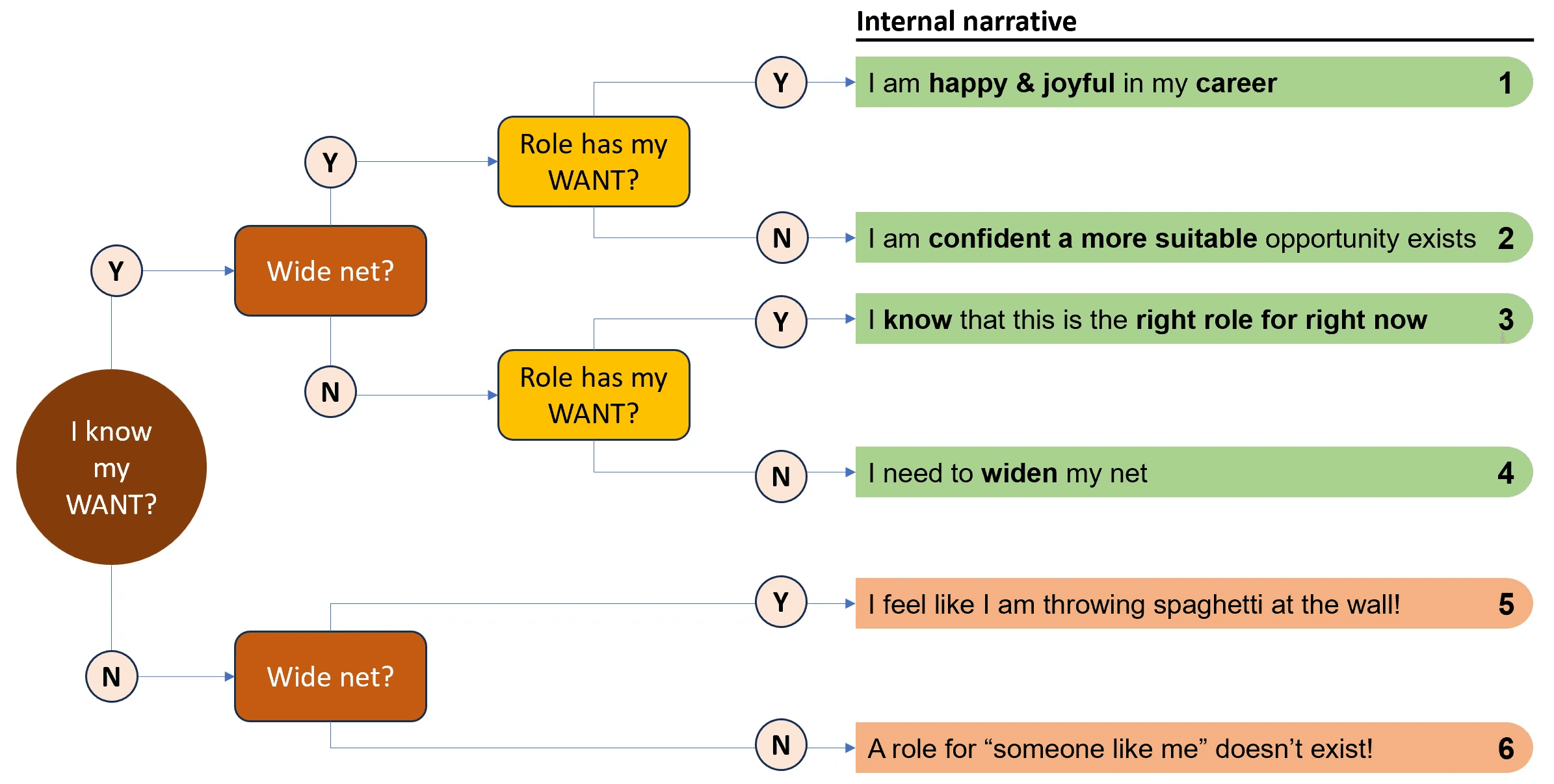
You need to know your WANTs before you take a new job. You need to know what trade-offs you are willing to make; and understand that these trade-offs are specific to you.
Doing the work together
By the time clients come to me they have done personality tests, taken online career profiles and even secured target roles, but there is a doubt about whether they are drawing the right inferences. I did all of these things, too.
This is why I, and my clients, find it essential to work with someone else. Someone who can help you analyze the different things you are looking for and help you give them names. Someone who can hold you accountable to yourself. Someone you can brainstorm with.
But the career consultant is not the only doing this through the process. Part of the process I take my clients through requires them to interview people about their jobs in detail to assess whether my clients' WANTs exist in their roles. This is a critical part of any job-seeking process that helps us manage confirmation bias, which manifests as thoughts such as: 'I'm not suitable for this role', or 'a role for someone like me simply does not exist'. Nothing eliminates a fantasy about a job (or yourself) when a person who actually has it tells you the nitty-gritty details and answers your specific questions about your unique WANTs.
Out of this emerges a confidence both in your target career and in your WANTs. With that knowledge you can make informed decisions throughout the length of your career.
Don't wait until you're desperate
Prior to working with a career consultant myself, I would often wait till I was desperate to leave, before starting to look at other jobs. With my frustration and urgency for change, I would only hear information about any job that confirmed I was right to leave my current one.
A good career consultant will be a steady guide to help you check your confirmation bias. I will help you understand everything that you WANT, support you through a process of talking to people who can help, and I will help you identify any other information you may lack, so that you can make good decisions.
I can help you do that.